

Prevalence of Headache Disorders Worldwide
According to the 2021 Global Burden of Disease report, headache disorders are among the most prevalent conditions in the world.1 For many, the occasional headache episode can be easily treated with an over-the-counter medication. For others, though, headache can be an intensely painful, frightening, and disabling condition that impacts daily life.
Over the years, headache researchers have identified and cataloged a wide variety of headache types. This article provides an overview of the most common types of primary headache disorders, including how the medical field classifies them and their common symptoms.
Understanding the similarities and differences between headache types can arm you with valuable information when seeking effective medical care and a greater understanding of your condition.
Headache Classification Framework
Developed by the International Headache Society and published for the first time in 1988, the International Classification of Headache Disorders (ICHD) framework is the primary diagnostic framework for diagnosing headache disorders.2 The ICHD-3, published in 2018, is the current version used by healthcare professionals to accurately diagnose headache disorders.
The ICHD is structured hierarchically, with the top level of the framework classifying headache types into two main categories — primary headache and secondary headache — and providing increasing detail from there.
According to the ICHD-3, primary headache is a disorder all by itself; headache disorders included in this category are not caused by any other condition. Examples of primary headache disorders include migraine, tension headache, and cluster headache.
Secondary headache, however, is a secondary symptom of another disorder, such as an infection (e.g., meningitis, sinus infection), medication overuse (rebound headaches), or a traumatic head injury (e.g., a concussion).
In part 2 of this article, you can read more about secondary headache disorders.
Other diagnostic criteria include:
- A minimum number of attacks or symptom days in a given timeframe,
- An individual’s current symptoms, rather than symptoms over a lifetime,
- An individual’s collective symptoms and experience are not better accounted for by another ICHD-3 diagnosis.
Each type of headache has its own set of diagnostic criteria in addition to those listed above, and individuals can be diagnosed with and treated for multiple, separate headache disorders. While frequency and severity are often captured by doctors in patient notes, and influence treatment approaches, they are not considered diagnostic criteria.
It is important to note that this is a simple overview of the ICHD framework. Having even a basic understanding of how it is structured can be helpful. Knowing the definitions of common headache types and how doctors use the ICHD-3 can assist you in preparing for appointments, educating and advocating for yourself, and getting an effective treatment plan in place.
“In primary headache, the headache itself is the disease. I mentioned two of them. There’s migraine, and there’s cluster headache that are caused by something, but it’s not something separate. The brain is making these spontaneously. It’s not a brain tumor or something like that. Secondary headache is a brain tumor or something else, which incidentally is causing pain in the head and a headache.”3
Types of Primary Headache Disorders
The most common types of primary headache are: migraine, tension-type, and cluster headache.
Migraine Headache
Migraine is a primary headache disorder estimated to impact 14% of the global population and occur three times more frequently in women than in men.1
Untreated, migraine attacks last anywhere from four to 72 hours and cause at least two of the following symptoms:19
- pain on one side of the head,
- a pulsing sensation,
- moderate or severe pain,
- an aggravation of symptoms with common physical activities like walking or carrying groceries.
During an attack, individuals will also experience at least one of the following:19
- nausea and/or vomiting,
- sensitivity to light (photophobia),
- sensitivity to sound (phonophobia).
There are several types of migraine, including migraine without aura, and migraine with aura, and they can differ greatly in how they present. Migraine with aura can include numbness, weakness, trouble with language, and visual disturbances prior to the head pain. Also, migraine with aura can sometimes occur without any head pain. According to the International Classification of Headache Disorders (ICHD), this form is officially defined as “typical aura without headache” or acephalgic migraine.23 However, people often refer to it as silent migraine.
Another example is vestibular migraine, which is also considered migraine with aura. However, the vestibular system is impacted in this case, so aura symptoms can feel like dizziness or vertigo.
For more information on the differences and similarities, read our article on the different types of migraine; you can also learn more about triptans and other medication for migraine headache.

The migraine diagnosis also differs between episodic and chronic.
According to the ICHD-3, episodic migraine is defined as experiencing headache and/or other migraine symptoms on fewer than 15 days per month.5 Chronic migraine is defined by having headache on 15 or more days each month, and on at least eight of those days, the pain feels like a migraine. And this needs to last over a period of at least three months.7
About 1-2% of the general population, and about 8% of those who are living with migraine develop chronic migraine.4
In this article you can find more information about what chronic migraine is and how to treat it.
Tension-Type Headache
Tension headache, or stress headache as it is commonly known, is classified as tension-type headache (TTH) in the ICHD-3.
According to the ICHD-3 and various studies, tension headache is so common that it impacts anywhere from 30% to nearly 80% of the global population.6 One of the challenges of diagnosing tension-type headache, however, is that people with frequent headache attacks tend to experience both migraine and tension headache, not just one or the other.8
Tension-type headache is classified into infrequent, frequent, and chronic subtypes. The main differentiators between these subtypes are the number of attacks occurring within a specific time period and the number of symptoms displayed during an attack.9
Common symptoms across the subtypes include: pain on both sides of the head, a pressing or tightening sensation, mild to moderate pain intensity, and attacks lasting minutes to days.9
In the cases of frequent and infrequent episodic tension headache, symptoms are not aggravated by common physical activities, and there is no nausea or vomiting. Chronic tension headache, which is defined as tension headache occurring more than 15 days per month for more than three months, can be associated with mild nausea, and sensitivity to light or sound.9
Dr. Lawrence C. Newman talks about how tension-type headache and migraine can coexist, and how to treat them. The video is from the 2019 Migraine World Summit.
Trigeminal Autonomic Cephalalgias
Trigeminal autonomic cephalalgias (TACs) are a type of headache disorder that shares the feature of a one-sided headache. It usually also displays symptoms such as nasal congestion and a runny nose, watering eyes, and drooping or swollen eyelids on the same side as the headache. These symptoms are known in medicine as cranial parasympathetic autonomic features. Some of the most commonly-known TACs are cluster headache and hemicrania continua.
“The other thing that’s very common in these disorders and have to be present to meet the diagnostic criteria is they have what we call one-sided or unilateral autonomic features. The autonomic nervous system is a part of our nervous system that is in control of our fight and flight reactions. With that system, when it becomes activated in patients that have TACs, or Trigeminal Autonomic Cephalalgias, such as cluster headache, they will have symptoms where they have tearing of one eye.”13
Cluster Headache
Cluster headache is one of the most painful pain disorders an individual can experience, and it is experienced almost three times more by men than women, though the reason why is currently unknown.16
A cluster headache attack is identified as an attack of severe pain on one side of the head in the eye socket, forehead, temple, or a combination of these locations. The pain can spread to other regions and is known to be excruciating, often preventing individuals from being able to lay down or rest. Attacks can last anywhere from 15 minutes to three hours, and can occur anywhere from once every other day up to eight times a day.16
Attacks also display at least one cranial parasympathetic autonomic symptom — for example, a runny nose, watering eye, or drooping eyelid — on the same side as the head pain, and/or general restlessness or agitation.16
Cluster headache occurs in a series or period of multiple attacks followed by a period of remission that can last months or even years. Reports show that 10-15% of individuals diagnosed with cluster headache experience the condition chronically — symptoms occur for one year or more with remission periods lasting less than three months or not occurring at all. And while some individuals only experience one attack period, they still should be diagnosed with cluster headache.16
Dr. Courtney Seebadri-White, assistant professor at Thomas Jefferson University, describes how cluster headache differs from migraine: “While someone experiencing a migraine attack will likely want to lie down in a quiet, dark room to rest, a person having a cluster attack is often restless and unable to sit still. This is due to a dysfunction of the nervous system, specifically within the trigeminal autonomic system. As with migraine, there is often a genetic predisposition, and sometimes an environmental trigger can set off the process. We still evaluate patients with cluster headache for possible secondary causes, but for the most part, treatment focuses on reducing the frequency and severity of attacks and ensuring that effective rescue options are available when they do occur.”10
Hemicrania Continua
Hemicrania continua, or HC, is another type of trigeminal autonomic cephalalgia with symptoms similar to other TACs, though it can often be misdiagnosed as migraine or cluster headache.Though the cause of HC is unknown, it is more commonly seen in women than men.11 Also, some individuals with HC can experience more severe headache pain after physical exertion or alcohol consumption.21
This particular disorder is a persistent, one-sided background headache that doesn’t change sides and lasts more than three months with spikes of increased intensity. HC displays cranial parasympathetic autonomic symptoms like a runny nose or watering eye on the same side as the headache and/or restlessness or agitation, and can also present with symptoms more commonly associated with migraine during exacerbation periods.20
Hemicrania continua is highly responsive to a medication called indomethacin, which is a non-steroidal anti-inflammatory drug (NSAID) often used to treat arthritis and other pain conditions. Because of the effectiveness of indomethacin in relieving HC symptoms, response to it is a diagnostic criterion for hemicrania continua.20 There are other pain relief medications that can be effective, as well, if indomethacin is not well-tolerated.
Dr. Shuu-Jiun Wang explains why hemicrania continua can be difficult to diagnose and is sometimes mistaken for new daily persistent headache: “We often think about new daily persistent headache when evaluating patients, but not always in the same way others might. Many people associate it with a tension-type headache, have pain on both sides of the head that’s mild to moderate in intensity. In contrast, hemicrania continua typically affects only one side. While tension-type headaches are usually bilateral, hemicrania continua is one-sided and much less common. In fact, it’s even rarer than new daily persistent headache.”12
Other Primary Headache Disorders
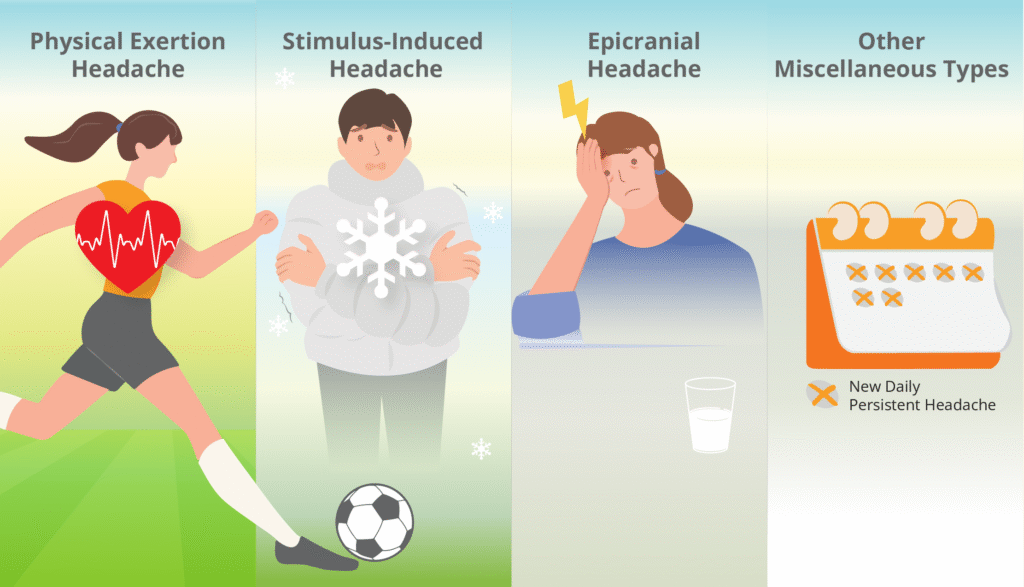
Other primary headache disorders are those that do not fit into a better primary headache disorder diagnosis. These disorders are grouped into four different categories under the umbrella of “other primary headache disorders”:
- Physical exertion headache, such as headache caused by exercise, coughing, or sexual intercourse
- Stimulus-induced headache, such as headache caused by cold or external pressure
- Epicranial headache, or pain that is over the scalp, such as an ice pick headache
- Other miscellaneous primary headache types, including new daily persistent headache
Physical Exertion Headache
Physical exertion headache is fairly easily understood from the outside, but, critically, doctors must rule out some serious conditions on the way to formal diagnosis.
For example, cough-induced headache is classified by a minimum number of occurrences: the sudden onset of headache, headache occurring along with coughing or straining, and the length of each attack. Most importantly, the headache must not get worse or lengthen with exercise, and there needs to be no sign of a disorder around the brain.22
In the case of exercise-induced headache, the headache is brought on by and occurs only during or after strenuous exercise. One critical step in diagnosing this headache type is ruling out serious, potentially life-threatening conditions such as subarachnoid hemorrhage, arterial dissection, or reversible cerebral vasoconstriction syndrome.22
Exercise-induced headache tends to occur more frequently in women, and at higher temperatures and elevations.
“So it’s absolutely true that acute exercise can initiate migraine, whereas regular exercise can function as a preventive. And for many people, exercise will on rare occasions trigger migraine — but most of the time will not. There is another headache disorder called benign exertional headache, where exercise regularly triggers headache. So for people with benign exertional headache, which absolutely is not migraine, the story is that headache is regularly triggered by exertion — often more intense exertion. And it’s to be distinguished from exertional migraine, where exercise triggers a headache that meets all the diagnostic criteria for migraine.”14
Stimulus-Induced Headache
Stimulus-induced headache is a headache caused by an outside stimulus, such as exposure to cold or pressure.
Cold-stimulus headache is a short-term headache brought on by exposure to cold, either externally or internally. This includes headache brought on by cold weather or diving into cold water, as well as headache brought on by inhaling or ingesting something cold. A good example of a cold-stimulus headache from ingestion is what many call an ice cream headache or brain freeze.17
Cold-stimulus headache induced by ingestion or inhalation should resolve no more than 10 minutes after removal of the cold stimulus; headache induced by external exposure should resolve no more than 30 minutes after removal of the cold stimulus.17
External-pressure headache is brought on by either compression or traction. It’s worth noting that this is considered a primary headache disorder because the external stimulus doesn’t actually damage the scalp. For example, some people get an external-pressure headache from having their hair pulled too tightly into a ponytail (traction) or wearing a helmet during sports (compression).18
External-pressure headache comes on during compression or traction and should resolve within one hour of external pressure being removed.18
Thunderclap Headache
A primary thunderclap headache is a sudden and extremely severe headache that reaches full intensity within less than a minute, and lasts for five minutes or more.27
Because thunderclap headaches can be a sign of serious conditions such as bleeding, blood clots, or brain inflammation, these causes must always be ruled out first with medical tests and brain imaging. The diagnosis primary thunderclap headache is only made when all other possible causes have been excluded and no underlying disorder is identified.27
The headache types defined as stimulus induced headache can all present as thunderclap headache. If the headache is clearly linked to one specific trigger, such as coughing, exercise, or sexual activity, it should be classified under that type instead.27
In this video clip, Dr. Shuu-jiun Wang talk about thunderclap headaches. What is it? What you should do if you experience thunderclap headache? And how can it be treated? The video is from the 2021 Migraine World Summit.
Epicranial Headache
Epicranial headaches originate from structures outside the skull and may present as either primary stabbing headache or nummular headache.26
Primary stabbing headache, sometimes called an ice-pick headache, or described as jabs and jolts, is characterized by a single short, sharp stab of pain, or a series of such stabs, that appears suddenly and lasts only a few seconds. These stabbing sensations can occur anywhere on the head, often shifting from one spot to another, and are not caused by any underlying structural or nerve disorder.24
Most people experience only a few stabs per day, though the frequency can vary widely. The pain is usually brief; studies show 80% of stabs last three seconds or less. The pain is not accompanied by other symptoms such as tearing or nasal congestion. Primary stabbing headache is more common in people who also experience migraine, and the pain often appears in the same area typically affected during migraine attacks.24
Nummular headache, also known as a coin-shaped headache, causes pain that is confined to a small, round or oval area on the scalp, typically between 1 and 6 centimeters in diameter, without there being any structural issues.25
The pain can occur anywhere on the head, but it is most often felt in the parietal region, which is the upper part of the back of the head. The pain intensity is often mild to moderate, but occasionally severe. In 75% of published cases, the disorder has lasted for more than three months, and is defined as chronic, but there are also descriptions of pain lasting from seconds to minutes, to days. Nummular headache can only be diagnosed after other causes are ruled out as possibilities.25
Hypnic Headache
Hypnic headache, also sometimes called “alarm clock headache,” is a rare type of headache that only happens during sleep. The headache wakes you up, often at the same time each night, and typically lasts from 15 minutes to 3-4 hours after awakening. The pain is often mild to moderate, but can in some cases be severe.28
The pain affects both sides of the head in about two out of three people. In most cases the condition is persistent with daily, or near daily headaches, but episodic cases do occur, where the headaches are present on less than 15 days a month.28
Other possible reasons for getting headaches that wake you up from sleep should be checked for — especially sleep apnea, high or low blood pressure, or medication overuse. Doctors also need to rule out problems inside the brain. However, even if someone has sleep apnea, they can still be diagnosed with hypnic headache.28
Dr. Shuu-Jiun Wang, practicing neurologist and director of the Neurological Institute, Taipei Veterans General Hospital, explains that hypnic headache is related to the body’s internal clock, which is controlled by the hypothalamus. This is the same area linked to cluster headache and some migraine attacks. Hypnic headache is not that difficult to treat.12
“Lithium works for about 90% of my patients in my clinic. Some respond well to melatonin, and strangely, some patients also respond well to a cup of coffee before bed. The good news is that these headaches often come and go, and they don’t usually stay with you for life.”12
New Daily Persistent Headache
New daily persistent headache (NDPH) can have chronic migraine or tension-type headache symptoms, making it sometimes difficult to diagnose. However, the greatest differentiator between new daily persistent headache and these other chronic headache types is how the disorder comes on. With new daily persistent headache, the onset is very precise and memorable: There is a specific moment when the headache starts and it persists from there.15
“New daily persistent headache is exactly what it says it is: It’s new, it’s something the patient hasn’t had before; it’s daily — it occurs on a daily basis — and it’s persistent or continuous. It’s unremitting from its onset, or at least within the first 24 hours. And patients usually never get a waking moment free from that pain from that point onward.”15
To diagnose NDPH, the headache needs to continue for at least three months. This is a primary headache disorder that’s one of the most difficult to manage.15
Dr. David Dodick is a past chairman of the American Migraine Foundation, past president of the International Headache Society, and previous director of the headache program and sports neurology and concussion program at the Mayo Clinic. He explains how to differentiate new daily persistent headache and chronic migraine, which can seem similar: “The two can be almost indistinguishable from both a headache standpoint and an associated symptom standpoint. And by that, I mean the presence of nausea, sensitivity to light and sound, and so on. But what distinguishes it from other chronic and persistent headache disorders is the way in which it begins. So, new daily persistent headache is a headache that’s clearly remembered. And that’s unlike most other chronic persistent headache disorders, where there’s often a crescendo or a buildup over time.”
Dr. Dodick further explains that even though NDPH is defined as a primary headache disorder, there may be circumstances where it can be secondary. You can learn more about why this is, and the measures Dr. Dodick takes to rule out other diseases that can cause a persistent headache similar to new daily persistent headache in the following video clip.
Dr. David Dodick explains why new daily persistent headache is a diagnosis of exclusion, and how doctors must rule out infections, pressure changes, and other underlying conditions before confirming it. The video is from the 2022 Migraine World Summit.
Because the underlying biology of new daily persistent headache is still not well understood, there are currently no treatments developed specifically for this condition. However, since the symptoms of NDPH often resemble those of migraine, including a throbbing headache or pulsating pain, nausea, and sensitivity to light, sound, or touch, many of the same treatments are used.15
Similar to post-traumatic headache, which also lacks targeted therapies, new daily persistent headache is often treated with medications and approaches originally designed for migraine.
This makes sense, as both conditions appear to share a common biological pathway involving the trigeminal nerve. Migraine treatments work by blocking the transmission of electrical and chemical pain signals along this nerve, and by doing so, they may help relieve pain in new daily persistent headache as well.15
Conclusion
Headache disorders are complex and diverse medical conditions, affecting people in many different ways. Understanding the main types of primary headaches, and what differentiates them from secondary headache disorders, helps both patients and healthcare professionals identify the right diagnosis and treatment approach.
Determining whether the headache is primary or secondary is a crucial first step because secondary headaches are caused by another underlying condition, such as infection, trauma, or medication overuse; and treatment must focus on addressing that root cause. In contrast, primary headaches, including migraine, tension-type, and cluster headache, occur on their own and are diagnosed based on symptom patterns, frequency, and clinical history rather than imaging or laboratory tests.
Treatment approaches also differ between these categories. Primary headache disorders are typically managed with a combination of over-the-counter pain relievers like acetaminophen or ibuprofen, prescription medications, and non-medicinal strategies such as stress management, regular sleep, and exercise. For people living with primary headache disorders, it is crucial to track their headache frequency, severity, common triggers, and symptoms to get the right diagnosis and a good long-term treatment.
For secondary headaches, treatment targets the underlying cause, for example, adjusting medications, treating an infection, or managing a structural issue, rather than solely treating the headache itself. Identifying the correct type of headache is, therefore, essential to ensure safe and effective management.
As research continues to uncover the underlying mechanisms of the different types of primary headache disorders, treatment options are also evolving. Increased awareness and accurate diagnosis remain essential steps toward better management and improved quality of life.
