

Introduction:
Why Migraine is More Than Just a Headache
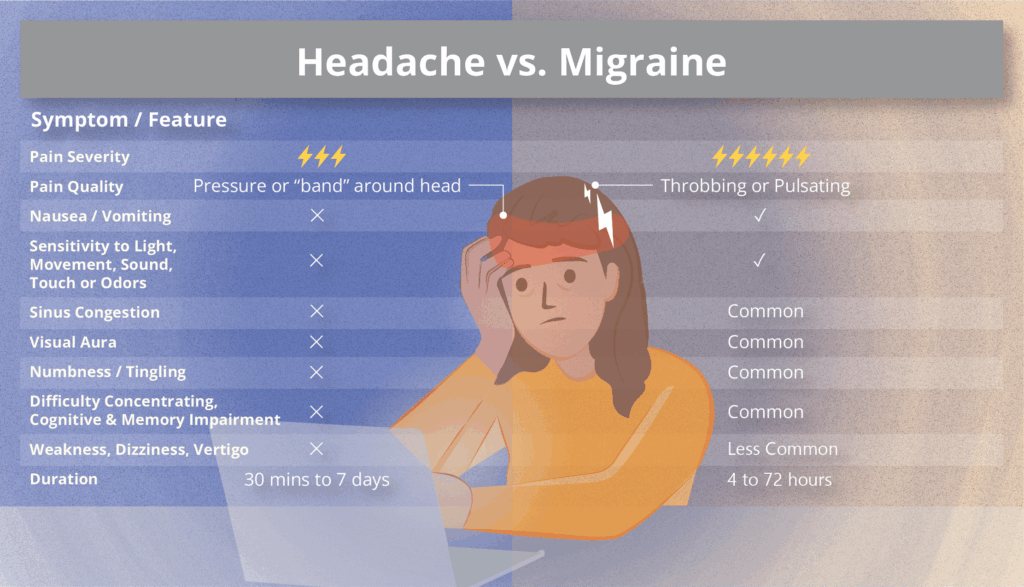
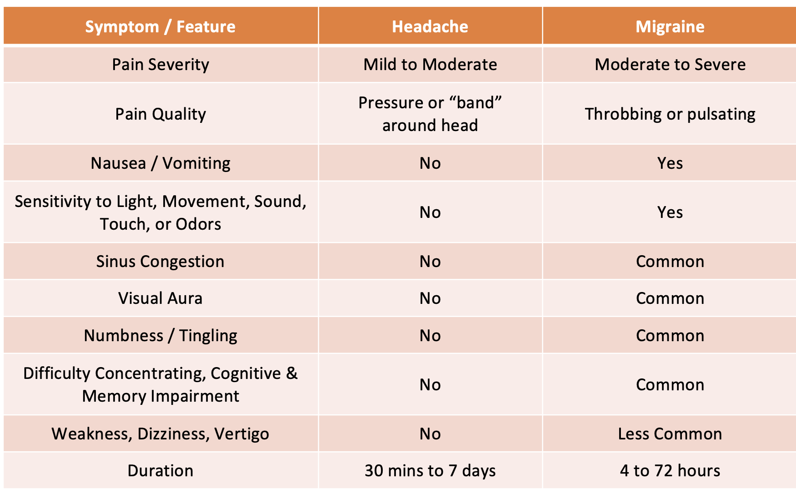
Although many people believe that migraine is simply a bad headache, this is a widespread misconception.
Migraine is, in fact, a neurological disease where headache is one of the symptoms.
In addition, people with migraine can suffer from a long list of ailments, which may include:
- Nausea and vomiting,
- Neck pain and muscle aches,
- Sensitivity to light, sound and scents,
- Fatigue,
- Dizziness or vertigo,
- Numbness or tingling,
- Visual disturbances, such as a temporary visual aura (which can include flashing lights, zig-zag lines,or other visual changes) and/or persistent visual phenomena (ongoing visual disturbances beyond the aura phase of a migraine attack),
- Cognitive issues such as brain fog, having trouble finding the right words, difficulty concentrating, and mood swings.
A migraine attack can affect systems throughout the body. This combination of physical and mental symptoms helps explain how a migraine attack can profoundly disrupt daily life.
Dr. Olivia Begasse de Dhaem, a neurologist and headache specialist who advocates for people living and working with migraine, shares how this disease can impact people’s lives very differently.5
She says that migraine affects people in different ways, and even one person can have different symptoms or varying presentations of the disease throughout their life. So, even within the same person, migraine is not always the same. Another element is the interaction between the disease and other factors of a person’s lifestyle, like the type of job functions they perform, their work hours, and work environment.
Why Migraine is a Significant Workplace Issue
Migraine affects over a billion people worldwide.8 One of the reasons why migraine is such a common condition in the workplace is that its peak intensity occurs in peoples’ 20s and lasts until their 40s.7
In fact, migraine is the leading cause of disability among young women. As many as one in four women aged 35 to 55 struggles with migraine during what should be the prime years of her career and family life.2
Even with acute and preventive therapies, migraine still disrupts the lives of 90% of those affected, impacting many parts of their lives, including work, cognitive function, and emotional health.4
Migraine is also a widely underdiagnosed and undertreated condition, with its severity often underestimated by healthcare professionals.9 Studies show that 45% of people with migraine hesitate to seek medical care, and 42% of those who hesitate never sought migraine care.18
Impact of Migraine at Work
Absenteeism vs. Presenteeism
When examining the impact of migraine in the workplace, we distinguish between absenteeism and presenteeism.
Absenteeism is when a person is absent from work because of migraine.
As many as 90% of those living with migraine say that they are not able to work fully during a migraine attack.19 Studies show that people living with migraine miss an average of 4.4 more workdays per year than those without the condition.16
Presenteeism, or functional impairment, refers to when a person with migraine experiences an attack during work hours and continues to work, but with reduced productivity. They are functionally impaired. The vast majority of migraine-related productivity loss is due to presenteeism.6 On average, people living with migraine experience reduced productivity on 11.4 workdays each year.16
“Eighty-nine percent of migraine-related productivity loss is due to presenteeism. So, people come and are present at work, but they’re not as productive as they normally would be because of all the symptoms of the disease.”
When experiencing a migraine attack, people are about 50% as effective as they are normally.5 This is explained to be due to the head pain and other symptoms, the unpredictability of the attacks, comorbidities, and emotional impact. On top of being underdiagnosed and poorly managed, migraine also carries a stigma that affects people living with the condition.
Studies show that even on non-headache days, migraine can negatively impact work productivity as well.6 About 40% of people living with migraine have symptoms, such as trouble with focusing, decision-making, thinking quickly, and remembering things, in between their migraine attacks. In addition, cogniphobia, the fear that mental exertion might trigger another migraine attack, may interfere with work productivity as well.6
Global Epidemiology and Impact (prevalence, direct and indirect costs)
As mentioned, migraine is a widespread condition, impacting roughly 14-15% of people around the world.1 More than 1 in 7 employees live with migraine,14 and according to The 2019 Global Burden of Disease Study, migraine is the second leading cause of disability worldwide,2 more common than asthma, diabetes and epilepsy combined.3
According to Dr. Begasse de Dhaem, the workforce includes a diverse mix of individuals living with both episodic and chronic migraine. She also says that approximately 46% of those with low-frequency migraine are able to work full time, whereas only 35% of individuals with chronic migraine manage to maintain full-time employment.
When it comes to the direct and indirect costs of migraine in the workplace, it is difficult to pinpoint a clear or definitive number. This is particularly true given that 89% of migraine-related productivity loss is due to presenteeism, and currently, there are no standardized methods for measuring presenteeism.6
That said, several studies estimate that the cost of presenteeism in the workplace is 3-10 times higher than the cost of absenteeism due to migraine.6
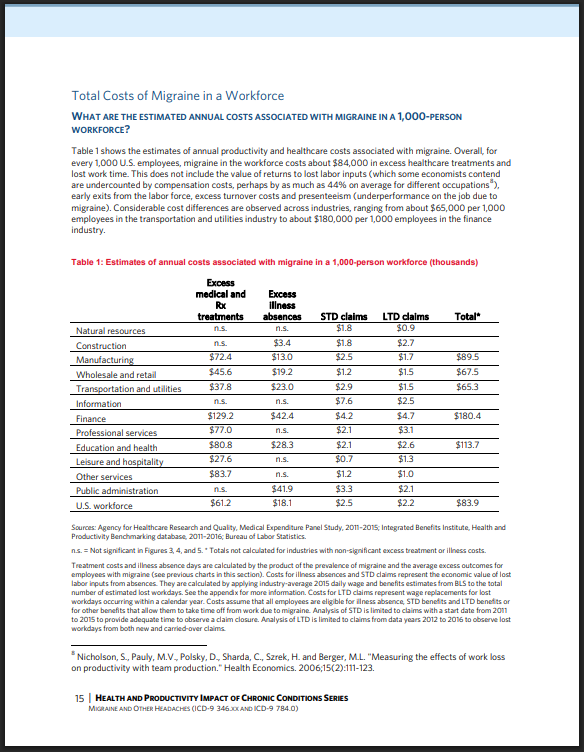
According to estimates from the Integrated Benefits Institute, for every 1,000 U.S. employees, migraine costs approximately $84,000 in excess healthcare expenses and lost work time.10 This figure does not include lost labor input, early exits from the workforce, excess turnover costs, or the impact of presenteeism.10
In the U.K., a report from the Work Foundation estimates that migraine costs the economy £8.8 billion per year in lost productivity.11 The same report also states that approximately 86 million workdays are lost annually due to migraine, and that close to £1 billion is spent on healthcare costs due to migraine.11
A European study called Eurolight found that migraines cost the EU economy around €27 billion each year in lost productivity.15 Most of this loss happens because employees don’t perform as well at work, or because they quit their jobs, mainly because they don’t get the support they need.
In addition, there is a huge personal cost for people living with migraine. The burden of migraine-related disability and productivity loss due to the disease can negatively impact a person’s career choices, job status or security, financial situation, workplace relationships, mood, and self-confidence.6
How Migraine Attacks Can Be Triggered At Work
For individuals living with migraine, the work environment can contain several triggers that may increase the risk of an attack. Being mindful of these factors can help reduce the frequency and severity of episodes.
Common workplace-related triggers include the following:17
- High or inconsistent stress: Sudden changes in workload, high pressure, or the feeling of lack of control
- Bright lights: Especially fluorescent lights or glare from screens
- Excessive screen use: Long periods in front of a computer without breaks
- Unsociable work hours or shift work, which can cause irregular sleep patterns
- Loud noises or constant background noise from people, machinery, etc.
- Poor diet: Skipping meals or irregular eating habits
- Bad posture: Prolonged sitting in non-ergonomic positions that cause tension in the neck and shoulders
- Sharp smells or fragrances: i.e., strong perfumes, cleaning agents, or industrial odors
Recognizing and addressing these triggers, both individually and at the organizational level, can help create a more supportive and inclusive work environment for employees with migraine.
When talking about triggers, it is important to recognize that there is often an excessive focus on migraine triggers, even among healthcare professionals. A person living with migraine can do their best to avoid or manage known triggers, and still get migraine attacks. Migraine is a neurological disorder characterized by recurring attacks that are often caused by things outside of one’s control, such as unforeseen stress, weather changes, and hormonal shifts.
When asked at the 2021 Migraine World Summit what type of work might be best suited for those living with frequent or chronic migraine, Melanie Whetzel, lead consultant of the cognitive/neurological team at the Job Accommodation Network (JAN), replies: “We can’t tell people with migraine — or any disability — what the best job is for them, but we recommend focusing on key concerns. If lighting is an issue, avoid large offices or retail spaces, and opt for a private office, cubicle with adjusted lighting, or remote work. If fragrances are a trigger, avoid florists, department stores, or malls with scented products. For noise sensitivity, consider noise-canceling headsets, earbuds, or soundproofing panels. The main point: Identify and avoid work environments that worsen migraine.”13
What People With Migraine Worry About In The Workplace
Juggling work and the unpredictability of living with migraine can often lead to a hidden burden that goes far beyond physical symptoms. Many worry about job security. They fear that their frequent absences or reduced productivity may put their employment at risk or limit opportunities for promotion and career advancement.
“The thing I hear the most commonly in my practice when seeing patients is a fear of being fired or having to quit the job because of all of the symptoms of the disease, but also because of the stigma.”
In a survey of over 200,000 U.S. workers, only 22% of them found migraine to be a serious enough reason to miss work.6 Because of this, many may also struggle with the decision of whether to disclose their diagnosis, unsure of how it will be received.
Lack of understanding from colleagues and managers can add to the stress of the disease itself. Many feel guilty or even ashamed when an attack affects their ability to contribute, and they may avoid speaking openly about their condition out of fear of being stigmatized or seen as unreliable.
According to Whetzel, the fact that migraine is an unseen disability can make navigating the workplace especially challenging.13
Whetzel says: “If somebody’s lost an arm, and they come into work, I think people kind of have an idea of what they might be able to do, and what they might have difficulty with. But for someone with migraine — if you don’t have migraine, if you don’t have someone in your family with migraine — then it might be more difficult for you to really think about, ‘OK, what really are the issues?’ ”
This emotional strain, combined with the neurological impact of the condition, can lead to lower self-confidence, increased stress, and a sense of isolation. Addressing these concerns requires not only awareness, but also a supportive and flexible work environment that takes invisible illnesses seriously.
Coping With Migraine Stigma At Work
Migraine stigma is everywhere, coming from coworkers, family, friends, doctors, as well as institutions such as health insurance agencies and the media; and it can be internalized. In fact, studies show that there is more stigma against chronic migraine than any against other neurological disease.5
In a survey of 2,000 people in the U.S. who didn’t have migraine themselves but knew someone who did, many had negative views:6
- 39% said people with migraine tend to hide their condition.
- 35% believed the attacks were caused by the person’s own unhealthy habits.
- 32% thought people with migraine exaggerated their symptoms.
- 31% believed migraine was used as an excuse to get out of work or school.
- 29% felt they made things harder for their coworkers.
Because of this kind of stigma, more than half of workers who stay home due to migraine keep the reason to themselves.6
This often makes it harder for people with migraine to do their best at work. When people feel that work is difficult because of their migraine, they also tend to report more disability and worse impact, when filling out the Migraine Disability Assessment (MIDAS) scale.6
“I think most people hide their migraine at work. And I think taking a step back, it’s not necessarily that they want to hide it, but migraine is highly stigmatized. It’s the most stigmatized of the neurological diseases — stigmatized at work, in language, institutions, in medicine — I mean it’s stigmatized everywhere. So as a result to people, you kind of internalize stigma and self-stigmatize and that sometimes, subconsciously and involuntarily, leads to concealment.”
Dr. Begasse de Dhaem believes that an important way to fight stigma is by talking openly about migraine and helping others understand what it really is.
She explains, “When people with migraine share their experiences, it helps others see that they’re not so different; they just face extra challenges, especially at work. Explaining the condition can lead to more understanding, more support, and less judgment. Of course, not everyone feels safe opening up, especially in a toxic work environment where there’s a fear of being treated unfairly or even fired. It takes courage to speak up, and not everyone can or should do it. But for those who can, being open can help the whole migraine community. It can also lead to feeling more seen, heard, and appreciated.”
She adds, “… living and working with migraine is hard, and people deserve recognition for showing up and doing their best despite the pain.”
Here you can read more about migraine and stigma.
Disclosure and Communication
What Employers Need to Know About Migraine
If you are an employer who has employees living with migraine, it is important that you acknowledge that this neurological disease is so much more than just a bad headache. The unpredictable nature of migraine makes it challenging for employees to manage without support and flexibility, and the stigma surrounding migraine often leads to it being underestimated.
By fostering a more informed and supportive workplace culture, employers can reduce stigma and help employees with migraine feel safe and valued. When people feel understood and supported, they’re more likely to stay in their jobs and do their best work.
It is also important for employers to recognize that people living with migraine often develop valuable qualities that can benefit any workplace.15
Carl Cincinnato, executive director at Migraine at Work, explains in a recent webinar on Navigating Migraine in the Workplace: Strategies for Success: “As they learn to balance work with a chronic health condition, skills like flexibility, endurance, empathy, time management, and problem-solving are sharpened through navigating daily challenges. As a result, people with migraine can be highly resourceful, committed, and collaborative. Some of your most talented and resilient team members may, in fact, be those living with migraine.”17
Pros and Cons of Disclosing Your Migraine at Work
Speaking openly about migraine at work can have both significant advantages and potential drawbacks.
On the positive side, being open about your condition can make it easier to request accommodations and create a more supportive work environment. It may also allow you to qualify for legal protections, and provide greater job security by helping protect against unfair dismissal. Sharing your experience can also build a sense of community and offer support to others, while allowing you to be your authentic self and feel more accepted.
However, there are also drawbacks to consider. Disclosure might lead to fewer career opportunities, reduced privacy regarding your health, and the risk of being seen as overly sensitive or even being labelled a hypochondriac.
Weighing these pros and cons is important when deciding whether to speak up about migraine in the workplace.
“Disclosing migraine at work can help reduce stigma through greater understanding and education. It is a really hard and brave thing to do that can benefit the wider community. But whether or not to share depends on the work environment, and it’s completely valid not to disclose if the setting feels unsafe or unsupportive.”
When and How to Talk to Your Employer
Deciding whether to talk to your employer about migraine can feel overwhelming, but in some situations, it can make a real difference. Opening up may lead to better support, more understanding, and practical changes that improve your daily work life.
Here are some signs that it might be the right time to start the conversation:15
- If migraine is affecting your performance at work or getting worse
- If reasonable accommodations could make a big difference
- If you need help from HR to challenge a denied health or leave benefit
- If you are a care partner of a family member who is struggling with migraine
- If you want to see the work environment and culture become more supportive and help others who may be struggling
Telling your workplace that you live with migraine isn’t always easy, especially in environments where stigma still exists. That’s why it helps to prepare. Think about what you want to say, what support you need, and how migraine affects your job.
It can help to talk about it with your doctor or someone you trust. Try to find allies at work or in support groups. If you can involve your supervisor, they might be able to make small changes that help a lot.
Dr. Begasse de Dhaem advises, “It’s important to stay true to yourself, and do what feels right for you. Many people with migraine carry guilt, often because of stigma, and feel like they always have to push through. But do you really have to attend that late work event? How does your body feel? Sometimes it’s OK to say ‘no.’ Others might simply say, ‘We missed you,’ and move on. Society teaches us to push through pain, but it’s worth pausing to ask: ‘What do I really need right now?’—not what I feel I should do.”
Rights and Legal Protections
What Counts as a Reasonable Accommodation
According to Melanie Whetzel with JAN, simple, low-cost accommodations can make a big difference for employees living with migraine.13
“Most of the accommodations for individuals of migraine are inexpensive; either they don’t cost anything at all, such as, you know, creating a space for individuals to lie down, or they’re under $500. So it’s really, really inexpensive to create changes that can have a huge impact.”
Frequently requested options include:
- flexible scheduling
- working from home
- lighting adjustments
- noise adjustments
- fragrance-free workspaces
- access to quiet spaces
“It’s important to talk with the person to understand their work conditions and what’s realistically possible. The key is to adjust based on the individual’s needs and environment,” says Dr. Begasse de Dhaem.
If you’re afraid to ask for accommodations at work, a doctor or headache specialist can be a helpful ally. They can write a letter of support or communicate with HR on your behalf, often without disclosing the specific diagnosis.5 This protects your privacy while still explaining that you have a serious health condition and need support.
Talking with healthcare providers, support groups, or even a social worker can help you feel more prepared and confident to ask for the adjustments you’re legally entitled to.5
Whetzel encourages employers and employees to experiment with short-term adjustments to see what works.13
“We often recommend temporary or trial accommodations. Working from home is a good one to try on a trial basis, because the employer is not locked into anything. With a trial period, an employee can show the employer if they can work from home and be as productive,” Whetzel explains.
Snapshot of Protections for People Living with Migraine
Many countries have laws that protect people with disabilities from unfair treatment at work. While the wording may differ, the core principles are similar: If your disability significantly affects your ability to do daily tasks or job functions, you may be entitled to reasonable accommodations and protection from discrimination.
Here’s a quick look at some of the disability acts from different countries:
- US: Americans with Disabilities Act (ADA)
- UK: Equality Act
- EU: Employment Equality Directive
- AU: Disability Discrimination Act
Stacey Worthy, an expert in workplace law and health policy, explains how the Americans with Disabilities Act (ADA) applies to people living with migraine.
Worthy says, “The way the ADA works, it’s all on a case-by-case basis, so there’s not a list of conditions that automatically qualify as disabilities. Instead, you have to meet that definition of disability of an impairment that substantially limits one or more major life activities which, for many individuals with migraine, they absolutely meet that definition.”
In the video clip below, Worthy explains in more detail when these protections apply to someone living with migraine — and under what circumstances they might not.
Can You Get Fired Because of Migraine?
Many people living with migraine worry that disclosing their condition at work could cost them a promotion, or even their job, during the next round of layoffs. But is that actually legal?
According to legal expert Stacey Worthy, the answer is: “It depends, but generally, no.”12
Employers are not allowed to fire someone because of a disability like migraine. However, they can let someone go for reasons unrelated to the condition, such as a company-wide layoff.
Worthy says, “They’re also allowed to let you go if your condition could pose a direct threat to your health or safety or the health and safety of someone else. So, let’s say you have migraine with aura, which is creating a visual impairment, and you’re a truck driver. That could potentially be a direct threat to the health and safety of yourself and others, because you could potentially get into an accident.”
She adds, “And then the other instance is if you’re unable to perform the essential functions of your position, they could potentially let you go for that reason as well.”
Tips for Managing Migraine at Work
Managing migraine at work isn’t always easy, but small changes can make a big difference. Whether you’re working from home or in the office, these practical tips can help reduce triggers, ease symptoms, and support your overall well-being throughout the workday.
- Keeping a Journal and Identifying Triggers: Tracking your symptoms, environment, stress levels, and diet can help you identify patterns over time. While not all migraine attacks can be prevented, understanding how your body responds allows you to manage triggers more effectively and lessen the overall impact on your daily life.
- Utilizing a migraine management tool kit: Keep essential items at your desk or in your bag — like medication, sunglasses, a water bottle, earplugs, or snacks. Having what you need nearby can help you act quickly when symptoms begin.
- Taking micro pauses: Regular, mindful breaks throughout the day, while stretching or focusing on your breath, can reduce muscle tension and eye strain.
- Find a coworker who can be your advocate: As we all know, a migraine attack can come on all of a sudden and progress quickly. That is why it may be helpful to know someone has your back if you’re unable to speak for yourself at the moment. Find a colleague you trust who can support you during an attack or help explain your needs to others.
- Lifestyle modifications: Stick to a consistent routine with meals, caffeine, hydration, and sleep. Small lifestyle changes can reduce migraine frequency and make workdays more manageable.
Want to learn more? In this article you can read more about migraine and sleep.
Supportive Workplace Culture
What Employers Can Do Better for Employees With Migraine
In addition to what you previously read about accommodations, employers will benefit from building a migraine-friendly workplace.
People with migraine tend to be more productive at work when they feel satisfied in their job, have support from their manager, work in a positive environment, and have some control over how they do their tasks.6
One way to do this is to initiate a migraine workplace program. If the whole company learns about migraine, including those who don’t have it, the pressure to explain the condition over and over falls away from the people living with the condition. And as a big bonus, studies show that such programs cut absences due to migraine, increasing productivity during an attack, and decrease the costs due to migraine-related productivity loss.6
Migraine Workplace Programs
Migraine workplace programs are useful to educate employers and employees, which again can result in better understanding and a more compassionate work environment.
Such workplace programs usually follow three simple steps:6
- Teach all employees about migraine through a company-wide awareness campaign.
- Offer a voluntary and private way for employees to check if they might have migraine disease.
- Give those who are diagnosed the option to join a support program or get connected with treatment.
According to six prospective cohort studies in the U.S., workplace migraine education programs have shown great results:6
- Boosted productivity from 2% to 36%,
- Reduced sick days by 25%,
- Cut down the number of days people worked while having a migraine by 32%,
- Helped people get about 10% more done during migraine attacks,
- Lowered stigma surrounding the condition.
Case Studies
One standout example is the Fujitsu Headache Project, developed in partnership with the Japanese Headache Society and the International Headache Society’s Global Patient Advocacy Coalition.6
Through a combination of e-learning, workplace exercises, and virtual headache consultations, the program reached over 73,000 employees in Japan, making it one of the largest workplace migraine initiatives to date.
The results were impressive:
- 95% of employees completed the one-hour e-learning module.
- After the course, nearly 73% reported that their understanding and attitude toward migraine had changed.
- The percentage of employees who viewed migraine as a serious disease rose from 47% to 71%.
- Over 77% said their attitude toward coworkers living with migraine had become more supportive.
The program also included a virtual consultation service with headache specialists. Although only a small percentage (0.5%) of employees opted in, more than half of those who received consultations went on to visit a headache clinic and start treatment.
One notable example involved a woman with chronic migraine who had previously endured significant symptoms in silence. After beginning treatment, the impact of migraine on her quality of life dropped to just 10–20% of what it had been, and her productivity at work greatly improved. Her colleagues celebrated her recovery as a workplace success.
The program also introduced headache exercises as part of daily self-care routines, including neck stretches and tension-relief techniques, which were well received. The overall goal was not only to improve quality of life and productivity, but to create a workplace where people with migraine felt safe, understood, and empowered to seek care.
Fujitsu’s initiative has since become a global model for corporate migraine support and has been recognized by the International Headache Society’s Global Patient Advocacy Coalition (GPAC) for its leadership in creating a migraine-inclusive work environment.
Conclusion
Key Takeaways
Migraine is one of the most common, and most misunderstood, conditions in the workforce today. It affects not only physical health, but also cognitive function, emotional well-being, job performance, and career development.
In this article you have read about the many ways migraine can challenge people living with the condition, and the real stigma people still face. It also presents, however, promising solutions in forms of education, accommodations, workplace culture change, and legal protections.
Encouragement for Employees and Employers
To employers and managers: You don’t need to be a medical expert to make a meaningful impact. Listening, learning, and offering flexibility goes a long way. Creating a migraine-friendly workplace isn’t just the right thing to do, research suggests that it also will benefit the culture at your workplace and productivity.
It is important to recognize that when employers and employees work together to understand and support those with migraine, everyone benefits.
Where to Find More Information
- Migraine at Work
- American Migraine Foundation
- Migraine Canada
- The Migraine Trust
- Health Action Alliance
- European Migraine and Headache Alliance
- Global Patient Advocacy Coalition
- National Health Service England
- Fujitsu Headache Project
