
- Introduction: Difference Between Primary & Secondary Headache
- What Makes a Headache Secondary
- When to Seek Emergency Care: Recognizing Red Flags
- Main Types of Secondary Headache
- Headache After Injury or Vascular Events (trauma, stroke, aneurysm)
- Headache From Infection or Inflammation (meningitis, sinusitis)
- Headache from Substances or Body Changes (medication overuse/ withdrawal, low or high blood pressure, hormonal shifts)
- Headache Linked to Other Medical or Psychiatric Disorders (tumor, eye strain, depression)
- How Doctors Diagnose a Secondary Headache
- How Secondary Headaches Are Treated
- Conclusion
Introduction: Difference Between Primary & Secondary Headache
Headache disorders are divided into two categories: Primary headache disorders and secondary headache disorders.
In part one of this article, you’ll find everything you need to know about primary headache disorders that occur on their own, instead of as a result of another medical condition. Examples of primary headache disorders include migraine, tension-type headache, and cluster headache.
In this second part of the article you will learn about secondary headache conditions. These types of headache are signs of something else going on in the body. Taking a closer look at secondary headache types, we will discuss what can cause them, and how doctors are able to tell them apart from primary headache types like migraine.
What Makes a Headache Secondary
Secondary headache disorders are caused by an underlying condition or external factor that triggers the pain.
According to The International Headache Society (IHS) and its International Classification of Headache Disorders, ICHD-3, used by medical professionals to diagnose headache disorders, these are the known secondary headache disorders.1
Headache due to:
- trauma or injury to the head and/or neck
- a non-vascular intracranial disorder
- a substance or its withdrawal (often called medication overuse headache)
- an infection
- a disorder of homeostasis
- a disorder of various facial or cervical structures
- a psychiatric disorder
You can find a more detailed explanation of each of these in the section below called “Main Types of Secondary Headache.”
In this video, Dr. William B. Young, who is board certified in neurology, psychiatry, and headache medicine, talks about thunderclap headache. The video is from the 2018 Migraine World Summit.
Why Finding the Cause of a Secondary Headache Matters
With secondary headache disorder, addressing the underlying root cause is essential to relieving the headache and preventing it from returning.
In order to diagnose a secondary headache disorder, there has to be a diagnosis of another medical disorder known to cause headaches. Also, there must be clear evidence of a causal relationship.
According to the ICHD-3 this may be shown by the headache starting around the same time as the condition, worsening or improving as the condition changes, or having features that are typical of that condition. It must also be clear that the headache cannot be better explained by another headache diagnosis.1
When to Seek Emergency Care: Recognizing Red Flags
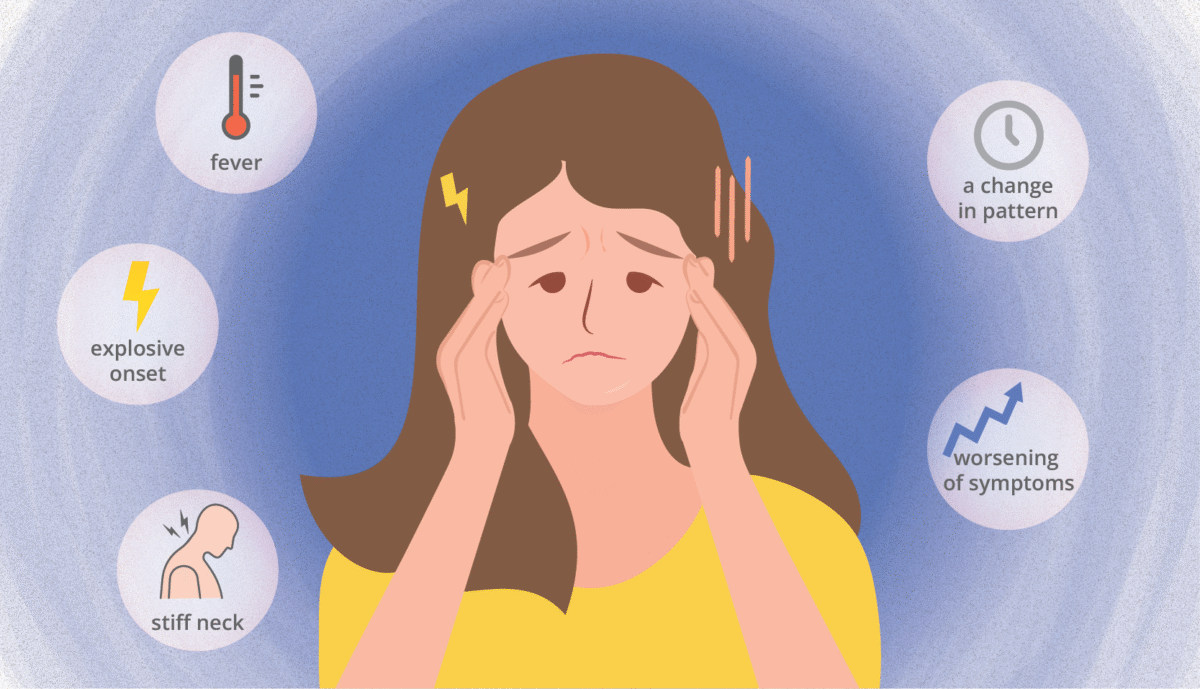
When diagnosing someone with headache symptoms, it is important to be alert to so-called “red flags.” The point of red flags is not to scare people, but to help rapidly identify the cases where headache could signal something urgent or dangerous.
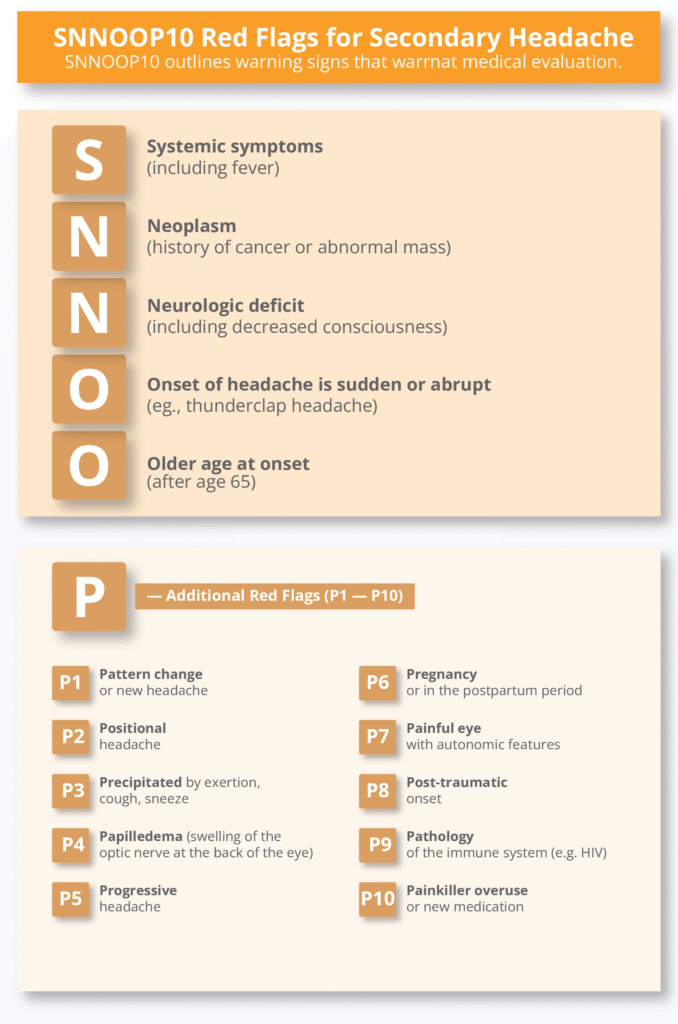
A useful mnemonic for this purpose is SNNOOP, which has later been expanded to SNNOOP10.2
The SNNOOP10 Explained
SNNOOP10 lists warning signs that a medical check-up is important, and stands for:2
- Systemic symptoms, including fever
- Neoplasm (an abnormal mass of tissue) in history
- Neurologic deficit (including decreased consciousness)
- Onset of headache is sudden or abrupt (eg., thunderclap headache)
- Older age (onset after 65 years)
- P1: Pattern change or recent onset of new headache
- P2: Positional headache
- P3: Precipitated by sneezing, coughing, or exercise
- P4: Papilledema (swelling of the optic nerve at the back of the eye)
- P5: Progressive headache and atypical presentations
- P6: Pregnancy or in the postpartum period
- P7: Painful eye with autonomic features
- P8: Post-traumatic onset of headache
- P9: Pathology of the immune system, such as HIV
- P10: Painkiller overuse (MOH) or a new drug at onset of the headache
Red flags do not necessarily mean something is wrong; they mean it is worth getting them checked out as soon as possible. If you experience any of these red flags, it is important to seek medical help.
See our article “Severe Headache and When to Worry” for guidance on when a severe headache needs urgent evaluation.
Main Types of Secondary Headache
As listed in the beginning of this article, the ICHD-3 defines eight different secondary headache types. To simplify, we have arranged these eight into four different categories.
Headache After Injury or Vascular Events (trauma, stroke, aneurysm)
Headaches that start after a head or neck injury, or due to problems in the blood vessels of the brain or neck, are considered secondary headaches.
Headache due to trauma or injury to the head and/or neck may often begin shortly after the triggering event and can feel similar to migraine or tension-type headache. A pre-existing headache can also become much worse or more frequent after an injury. These headache types often come with symptoms such as dizziness, fatigue, poor concentration, sleep problems, or mood changes, and are sometimes called post-concussion symptoms.3
A headache due to vascular events, such as stroke, aneurysm, artery dissection, or vessel inflammation, will often start suddenly and be clearly different from previous headaches. In some cases, the headache is an early warning sign before more serious neurological symptoms appear.4
These two secondary headache types are defined by ICHD-3 as:
- 5. Headache attributed to trauma or injury to the head and/or neck
- 6. Headache attributed to cranial or cervical vascular disorder
Headache From Infection or Inflammation (meningitis, sinusitis)
Some secondary headaches are caused by non-vascular problems inside the skull. These may include:5
- changes in pressure around the brain (either too high or too low)
- inflammation not caused by infection
- tumors
- seizures
- certain rare structural conditions.
Secondary headache disorders can be caused by infections affecting the whole body, such as viral illnesses like influenza, serious systemic infections like sepsis, or infections involving the brain or its surrounding structures, such as meningitis or encephalitis.6
A combination of headache, fever, and nausea or vomiting often points to a headache caused by an infection. The concern is even greater if the person also feels unusually drowsy or has seizures.6
Dr. William B. Young, board certified in neurology, psychiatry, and headache medicine, explains what meningitis is and why it requires urgent attention:
“Meningitis is an infection or inflammation around the coverings of the brain, and that can come out quickly or slowly over days or hours or even minutes. People get a stiff neck and often a fever. It’s clear that something is different with this type of headache, and they need to seek care and sometimes antibiotics urgently.”
In most cases, the headache improves as the infection clears, but in some people it can persist even after the infection has resolved.6
These two secondary headache types are defined by ICHD-3 as:
Headache from Substances or Body Changes (medication overuse/ withdrawal, low or high blood pressure, hormonal shifts)
In some cases, headaches are linked to substances the body reacts to, or to stopping a substance the body has become used to. This includes hormones, medications, alcohol, caffeine, and other drugs.11
A common example is medication overuse headache (MOH). People who use medications to treat a primary headache disorder, like migraine, can develop MOH as a secondary headache, as a result of their migraine treatment. This usually occurs when acute headache medicines are taken more often than recommended over a period of at least three months.7
Here you can read all about medication overuse headaches (MOH).
In many cases, the headache improves once the substance is reduced, stopped, or has been cleared from the body.7
Headaches can also occur when the body’s normal balance is disrupted, such as during changes in hormones, blood sugar, oxygen levels, or other internal systems.8
These two secondary headache types are defined by ICHD-3 as:
- 8. Headache attributed to a substance or its withdrawal
- 10. Headache attributed to disorder of homeostasis
Headache Linked to Other Medical or Psychiatric Disorders (tumor, eye strain, depression)
Headaches or facial pain can come from problems in structures of the head, neck, or face.9
Examples may include:9
- disorders of the neck (such as cervicogenic headache)
- disorders of the eyes (including acute angle-closure glaucoma, refractive error, and ocular inflammatory disorders)
- disorders of the ears
- disorders of the nose or paranasal sinuses (acute or chronic rhinosinusitis)
- disorders of the teeth
- temporomandibular disorders (TMD)
- inflammation of the stylohyoid ligament (a fibrous band connecting the skull to the neck)
Because many of these conditions are common and not all of them cause headache, careful evaluation is needed to determine whether the pain is truly linked to a structural problem.9
Here you can read more about sinus headache: causes, symptoms, and relief.
Evidence that psychiatric disorders directly cause headaches is limited. For this reason, headaches are only classified as secondary to a psychiatric disorder in a small number of cases where there is a clear and direct link.10
Psychiatric disorders mentioned in this context include:10
- depressive disorders
- anxiety disorders
- trauma- and stress-related disorders.
A coexisting psychiatric disorder can worsen the course of migraine and tension-type headache, making headache attacks more frequent, more severe, or harder to treat. Therefore, identifying and addressing any accompanying psychiatric condition is important in the overall management of headache.10
These two secondary headache types are defined by ICHD-3 as:
- 11. Headache or facial pain attributed to disorder of the cranium, neck, eyes, ears, nose, sinuses, teeth, mouth, or other facial or cervical structures
- 12. Headache attributed to psychiatric disorder
How Doctors Diagnose a Secondary Headache
When diagnosing a secondary headache, doctors start by taking a detailed medical history and performing a thorough physical and neurological examination. They also look for specific warning signs, red flags that are summarized in the SNNOOP10 criteria, that suggest the headache may be caused by an underlying condition rather than being a primary headache disorder.14
Doctors might use different types of scans or tests in this process. Professor Dimos-Dimitrios Mitsikostas, a specialist in headache, neurologist, council member of the European Headache Federation, and president of the Greek Headache Society, explains:
“We do need some tests, not to diagnose the headache subtype, but to exclude other brain disorders that may mimic that particular headache. If the headache is extremely acute, if the patient has recent headaches that started a few months ago, and they are aggravated within weeks or months, or if the patient is complaining of chronic headaches, and suddenly those headaches change features, change characteristics, then the physicians should consider a brain scan to exclude any secondary headache that might mimic a primary one.”
Determining a Headache to be Primary, Secondary or Both
The diagnosis of secondary headache is based on identifying a causal relationship between a headache and another disorder known to be able to cause headache. When a headache appears for the first time at the same time as such a disorder, it is always diagnosed as a secondary headache, even if it looks like a typical primary headache such as migraine, tension-type headache, or cluster headache.1
If a person already has a primary headache disorder and that headache becomes clearly worse or becomes more frequent at about the same time as another condition develops, doctors can give both a primary and a secondary headache diagnosis, provided there is good evidence that the other disorder can cause headache.1
Distinguishing Secondary Headache From Primary Migraine
Although secondary headache attacks can resemble migraine, careful clinical evaluation usually reveals important differences. Dr. Young explains that the key to distinguishing primary from secondary headaches is a careful history and thorough examination, with particular attention to red flags, such as those summarized in the SNNOOPP criteria.2
Dr. Courtney Seebadri-White, an assistant professor at Thomas Jefferson University, highlights that many secondary headaches are initially misdiagnosed as a migraine because they share symptoms such as head pain, nausea, dizziness, and cognitive fog.13
“So, a lot of folks will come to me with symptoms of migraine, but when I do my neurological exam, I will notice things like papilledema — the swelling in the back of the eyes — that suggests increased pressure, and that will lead me to look down the secondary route. And then when patients tell me things like they’re having tunnel vision or they’re hearing the whooshing in their ear, that also clues me in that this may be a secondary headache type,” explains Dr. Seebadri-White.
Dr. Courtney Seebadri-White further discusses how a secondary headache can be misinterpreted as a migraine. This video is from the 2024 Migraine World Summit.
Prevalence of Secondary Headache
According to a large population study from Norway, only about two out of 100 adults aged 30–44 had a chronic secondary headache over the course of a year. In that group, the most common type was medication-overuse headache.12
Dr. Young’s explanation matches what we see in the Norwegian study. And he emphasizes that secondary headache types are usually noticeable because they feel new, different, or clearly outside a person’s usual migraine pattern.
“Secondary headaches are rare. And I think that most of the time they’re quite obvious that something’s going on, and your body will tell you that this is new and different, and you need to pay attention to it. People with migraine are no more at risk for any secondary headache than anybody else in the world.”
How Secondary Headaches Are Treated
Dr. Young emphasizes that secondary headaches require a fundamentally different management approach than primary headache disorders. Treatment is directed at the underlying cause rather than the headache itself, and some secondary headaches, such as meningitis, arterial dissection, venous thrombosis, or ruptured aneurysm, are medical emergencies that need immediate medical attention.2
Conclusion
Secondary headache disorders are headache attacks that develop as a symptom of another underlying condition, rather than occurring on their own. While they are far less common than primary headache disorders, such as migraine or tension-type headache, identifying them correctly is crucial, as some secondary headaches are linked to serious or even life-threatening conditions.
The cornerstone of diagnosing secondary headache is a careful clinical evaluation. This includes a detailed medical history, a thorough physical and neurological examination, and attention to red flags summarized in the SNNOOP10 criteria.
Many secondary headaches can resemble migraine, which is why misdiagnosis may occur, particularly in the beginning. However, secondary headache attacks often feel new, different, progressive, or are accompanied by warning signs such as fever, neurological symptoms, sudden onset, or positional changes. Importantly, having migraine does not increase a person’s risk of developing secondary headaches.
Treatment of secondary headache focuses on treating the underlying cause. Knowing when to contact a doctor and being aware of warning signs can help you get the right evaluation and treatment at the right time.
